




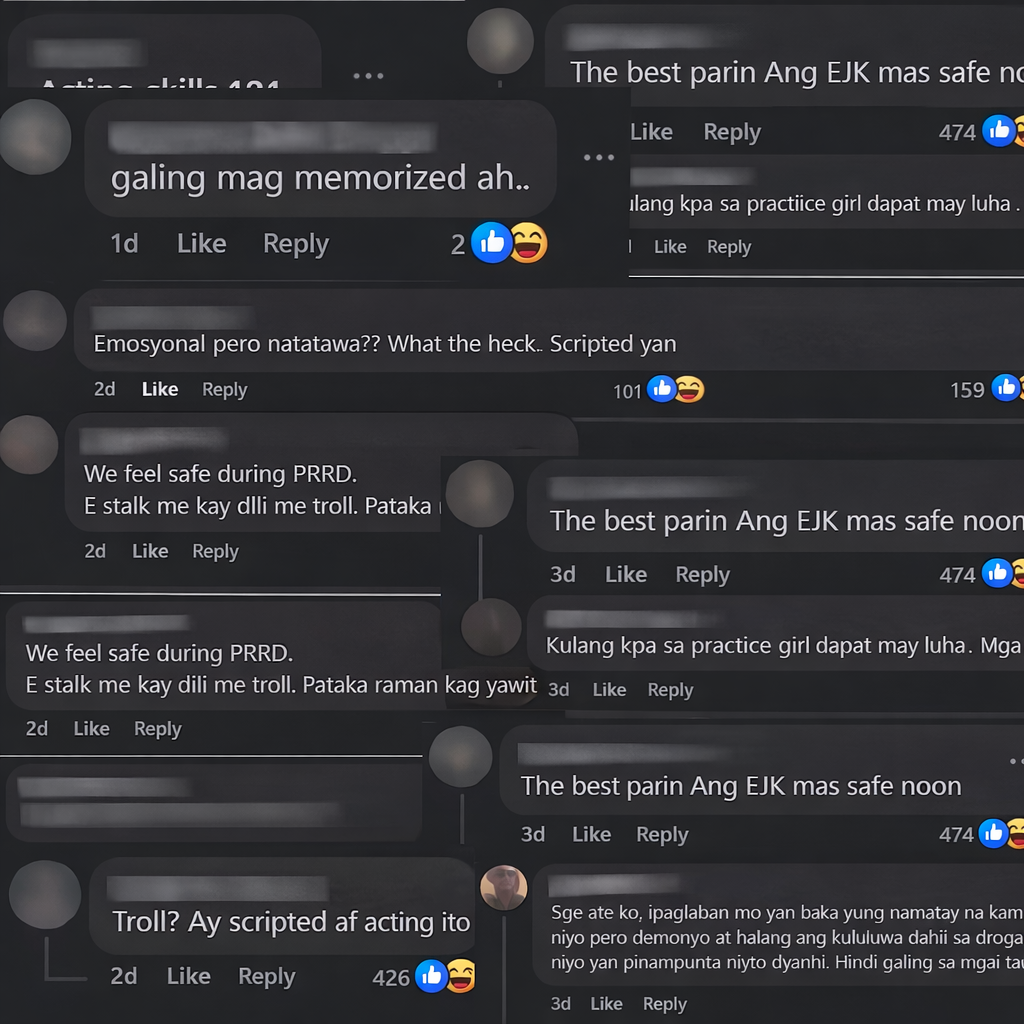
Filipinos have mastered the art of selective justice.
We discredit dissent as media manipulation. We dismiss uncomfortable data as fabricated. We reduce human rights violations to Facebook comment-section morality plays. And we do it with disturbing ease.
Under a video posted by ABS-CBN News covering Sheera Escudero’s presence in The Hague days before the confirmation of charges against former president Rodrigo Duterte, a commenter wrote:
“Gurl, wake up! Paano yung mga victims? Wala ba silang karapatan sa mundo? Dapat ba yung mga adik lang ang may protection at may human rights? … Mas mabuti na yung mga adik ang mawala kaysa sa mga inosenteng mga bata.”
This is the essence of conditional nationalism: a position shaped by misinformation and sustained by conclusions drawn from inference rather than evidence.
Sheera Escudero is not campaigning for the protection of criminals. She is fighting for justice for her brother, Ephraim Escudero—found dead in 2017 with gunshot wounds, his hands and feet bound, in a case widely reported as an apparent extrajudicial killing linked to the anti-drug campaign. There is no reliable reporting that he was convicted of murder. Human rights groups documented that he may have been misidentified. His family has been seeking justice for nearly a decade.
Nearly a decade.
Tragically, his case is not an exception to the norm. Thousands were killed in police operations officially linked to the drug war. Thousands more were documented by independent monitors as victims of vigilante-style killings. Yet the narrative persists that it was safer then. There were fewer drugs. The streets were disciplined.
The story is made simple because simplicity comforts. Drugs are the root of all crime. Eliminate drugs, eliminate crime. One man was strong enough to do what others were too weak to attempt. It is a myth sustained by repetition and protected by emotion.
When statistics challenge that myth, they are branded fake. When international scrutiny arises, it is framed as foreign interference. When grieving families demand accountability, they are accused of defending criminals.
Facts become optional when loyalty takes precedence.
The problem is not compassion for victims of crime. The problem is hierarchy, or the belief that some lives are inherently more worthy of protection than others. When you say “mas mabuti nang mawala ang mga adik,” you are not advocating for justice. You are endorsing execution without trial. You are saying suspicion is enough to strip a person of their rights.
That is not patriotism. That is preference.
True nationalism is far from convenient. It demands integrity. The principle at stake goes beyond the drug war. It is about whether we believe rights are conditional. If you demand justice for victims of violence, you must also demand due process for the accused. If you insist the state protect the innocent, you must also insist the state be bound by law. Otherwise, what you are defending is not justice — but vengeance. You cannot champion law and order while celebrating lawlessness when it targets people you despise.
Patriotism that activates only when it aligns with your political loyalty is not patriotism at all. It is factional devotion disguised in a flag.
There is also something deeply revealing about how quickly criticism of a leader is treated as betrayal of the country. A republic is not a person. It is not a surname. It is not a political dynasty. Holding a former president accountable through legal institutions is not an attack on the nation; it is the function of one.
If you believe the Philippines is governed by law, then you must accept that no leader stands above it. Otherwise, what you defend is not sovereignty, but supremacy.
Conditional nationalism says: I care about victims, but only certain victims. I believe in justice, but only selectively. I believe in rights, but only for those I deem worthy. But rights are not rewards for moral approval. They are protections precisely for when approval is absent.
The moment we normalize the idea that some Filipinos deserve death without trial because it is convenient, we erode the foundation that protects everyone else. Today, it is the suspected addict. Tomorrow, it could be the activist. The journalist. The critic. The ordinary citizen who happened to be in the wrong place at the wrong time. In truth, for many, that future has long since arrived.
Nakalimutan niyo na kung para kanino kayo lumalaban.
Nationalism is not about defending the pride of a political camp. It is about defending the dignity of people— all people— even those who cannot defend themselves.
If our love for our country requires us to mock grieving families, to deny documented deaths, and to treat accountability as treason, then what we are protecting is not the nation.
We are protecting our comfort.
And comfort has never been a substitute for justice.