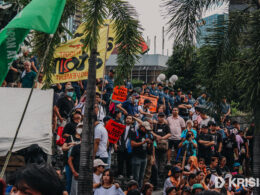





Judge Georgina Uy Perez of the Tacloban City Regional Trial Court (RTC) Branch 45 denied Frenchie Mae Cumpio’s appeal of her terrorism financing conviction on March 27.
Nothing about that decision was accidental. It followed nearly six years of detention, a series of charges that had partially collapsed, and a case built on evidence that has not held consistently across proceedings. And still, the ruling stands. For this case, the process is deemed sufficient.
Cumpio, a Tacloban-based community journalist, was arrested in 2020 and later convicted of terrorism financing. The charges stemmed from alleged financial transactions that authorities linked to armed groups, accusations she has consistently denied. Over the course of her detention, several related charges were dismissed, while one conviction remained.
There are two ways to read a decision like this. One is to accept it as the outcome of legal procedure. The other is to examine how similar situations have been treated and ask whether the same standards are being applied.
The concern centers on consistency. How courts respond to doubt has never been incidental to justice; it defines it.
Consider how courts have responded when evidentiary doubt accumulates.
In People of the Philippines v. Webb et al., the Supreme Court overturned convictions after finding that the prosecution’s case failed to meet the standard of proof beyond a reasonable doubt. The ruling did not preserve fragments of the case once credibility faltered. It required reconsideration of the entire structure.
Similarly, in People of the Philippines v. Hernandez, the Court resisted fragmenting a political offense into separate charges in a way that would multiply liability without strengthening proof. The principle at work was restraint. The Court rejected the idea of breaking a single political offense into multiple charges when doing so would only mask weaknesses in the overall case, rather than strengthening the evidence.
Taken together, these decisions point to a clear principle: when evidence becomes unstable, the integrity of the entire case is called into question. That principle feels harder to locate in Cumpio’s case.
.
Here, doubt does not spread in the same way. Charges fall away, but the remaining one holds. The conviction for terrorism financing stands even as other claims built from the same context collapse. Instead of destabilizing the case, those weaknesses are contained.
This reflects a distinct handling of uncertainty.
In high-profile cases, doubt tends to expand. It is examined closely and allowed to reshape the entire case. In less visible cases, often rooted in regions or sectors already burdened by suspicion, doubt is addressed selectively. It is acknowledged where necessary, then limited where it could disrupt the outcome.
While not codified in law, the difference manifests in practice.
The specific charge is critical. Because terrorism financing cases rely on interpreting associations and financial patterns rather than direct actions, they often leave a dangerous amount of room for assumptions to drive the verdict.
The stakes extend beyond a single trial. By defining these standards now, the court is shaping the framework for every future case of this nature.
Before her arrest, Cumpio had already been red-tagged. Her reporting placed her in communities long approached through a security framework. In that context, proximity takes on added meaning. Transactions are interpreted not only for what their function, but for what they are taken to imply.
This is where legal reasoning and political narrative intersect. The law outlines how evidence should be read. Red-tagging shapes how it is actually interpreted. What results is a case that appears procedurally sound, yet draws from assumptions that were never directly tested.
Once that framing takes hold, everything else follows more easily. Weaknesses lose their force. Delays become tolerable. Dismissed charges stop generating doubt because the broader story surrounding the accused remains intact.
Not every defendant faces that kind of environment
Cumpio is a community journalist. Her work depends on proximity — to sources, communities, and spaces often invisible in national discourse. That proximity is precisely what makes her reporting valuable. It also makes her vulnerable when viewed through a different lens.
In a system where association can be read as complicity, the risks of journalism shift. Accuracy is no longer the only measure. Neither is intent. What matters, increasingly, is how easily the act of reporting can be reframed as something else.
This is how a system shapes behavior without issuing a directive. It does not need to explicitly prohibit certain kinds of reporting. It only needs to show that those who engage in it can be subjected to long, uncertain processes that are difficult to exit once begun.
International groups such as Reporters Without Borders (RSF) have described the case as a travesty of justice. That label captures the outcome. More importantly, it points to a pattern: a process that stretches across years, absorbs inconsistencies, and still produces a conclusion it treats as sufficient.
The appeal’s denial does not settle the questions surrounding this case. If anything, it sharpens them.
Yet cases like this are often reduced to something simpler: guilty or innocent. It is an easier frame to engage with — and an easier one to step away from. When certainty is out of reach, disengagement becomes tempting. Distance makes it easier still.
The more difficult question has never been about certainty. It is about standards.
What level of evidence are we willing to accept as sufficient?
How long can detention be treated as part of the process rather than its consequence?
At what point do we recognize that the categories being used — terrorism, financing, association — carry assumptions that extend beyond the courtroom?
These questions do not stay contained within one case. They define the environment in which future cases will be argued.
The appeal has been denied. The ruling will stand, at least for now. What remains unsettled is how it will be understood: whether as an isolated outcome or as part of a pattern that demands sustained attention.
That choice no longer belongs to the courts.
It rests with those willing to keep looking, to keep asking, and to resist the ease of looking away. Supporting independent journalism, demanding transparency, refusing disengagement — these are not abstract responses. They are the conditions for accountability.
What are you going to do about it?