



Mental health has become one of the most discussed topics on social media, especially among younger generations. After years of efforts to fight the stigma surrounding it, recent events have made it so that this topic is no longer confined to whispers.
Speaking about personal struggles takes courage, and enduring them demands resilience. Choosing to be open reflects strength, not weakness—though some still mistake vulnerability for fragility rather than recognizing it as bravery.
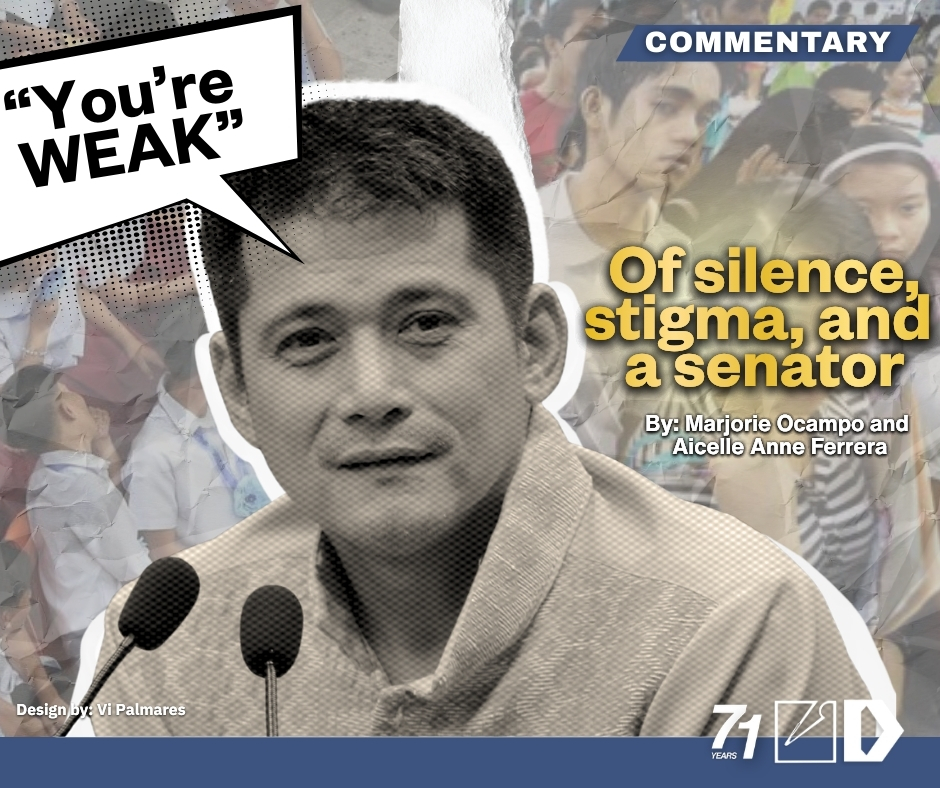
In a recent statement, Senator Robin Padilla stirred public conversation after expressing disappointment with what he perceives as the ‘weakness’ of today’s youth. Speaking candidly, the senator compared the present generation with his own, recalling a time when the word “depression” was rarely heard.
He admitted that he himself did not even know what “depression” meant back then. With a hint of disbelief, he remarked that today, even children casually say, “I’m depressed,” suggesting that what was once an unfamiliar term has now become part of their everyday vocabulary. He made a dismissive remark, as though one’s acknowledgement of struggle were something to be mocked rather than recognized as progress.
“Kids nowadays, sadly, please don’t get mad at me — oh, I’m sure many of you will get upset — but forgive me… you are weak,” Sen. Padilla said.
He made the remark during a hearing of the Senate Committee on Public Information and Mass Media, which he chairs, wherein he opened discussions on various measures concerning children’s safety on social media.
Authority amplifies impact.
Who in the Philippines does not know Robin Padilla? The action star-turned-legislator whose political career sparked widespread debate and dominated public discourse.
Hailed as a prominent actor, widely recognized as an action star, and dubbed the “Bad Boy” of Philippine cinema. Throughout his three decades in the industry, most of his filmography revolved around his rebellious and tough-guy persona, roles that consistently project stoicism— a representation of composure and emotional restraint.
Is this the kind of emotional fortitude Sen. Padilla envisions for the youth? One that dismisses emotional struggles as fragility instead of recognizing their legitimacy?
Is this the measurement of strength among his generation? One defined by toughness, aggressiveness, and heartlessness?
Perhaps it is not the youth who fall short, but Sen. Padilla’s very standard of strength.
As a highly influential figure to the masses, Sen. Padilla commands significant public attention, and his statements often shape broader social conversations. Online responses reflected a divided public perception, with many echoing in agreement while others condemned the remark, sparking debates between older and younger generations about mental health, resilience, and the language used to describe emotional struggles.
Supporters of Sen. Padilla’s view even pointed to online commentary, with one netizen writing, “You got to admit it though, a lot of people are milking that depression card nowadays,” highlighting the persistence of skepticism surrounding mental health discourse.
Words uttered in the halls of the Senate would inevitably reach beyond its walls.
These online commentaries illustrate the influence of Sen. Padilla on the public, providing a platform for netizens to more recklessly speak against mental health struggles, as his status as a highly influential figure lends weight to such opinions and normalizes dismissive attitudes toward emotional vulnerability.
A public official tasked with serving the people — especially Sen. Padilla — should arguably prioritize a person’s propensity to good governance and public service rather than drawing prescriptive judgments about the younger generation’s emotional resilience and worth. He not only invalidated the emotional struggle of today’s youth, but also further perpetuated the stigma surrounding mental health to prevail even more.
Not all that’s silent is at peace.
“Kami nga noon eh.”
“Noong generation nga namin.”
“Mga batang ‘90s nga eh.”
The familiar refrain has ricocheted across social media, symbolizing a broader sense of generational invalidation that surfaced after remarks from Sen. Padilla.
Among others, this is yet another case of how ‘Filipino resiliency’ is exploited as a means to evade accountability and long-term systemic failure.
It is not far from how the government responds to typhoons and natural calamities that continuously flood the homes of the Filipinos, season after season. Whenever storms hit the country, it has become a cycle of waist-deep floodwaters, climbing roofs to survive, and even lives lost–all of which are products of systemic greed and negligence.
In a similar pattern, the ‘pagtitiis’ culture ingrained in Sen. Padilla’s generation has allowed public servants to neglect proper mental health services and justify, even propagate, stigma surrounding the matter for decades.
As the masses are accustomed to wading through the storms of nature, they, too, have to brave the storms of life.
These storms are expected to be faced while still bearing in mind the three glorified signs of ‘strength’, as they know it: Smile, Struggle, Silence. However, this kind of mentality ingrains in the minds of people that they are meant to struggle, and thus, should always ‘smile through all the pain’ and never mention taboo concepts such as depression or vulnerability.
Even strong mountains can be destroyed when hit by a storm, yet this generation’s desire to appear strong reflects an enduring pursuit of resilience rather than surrender.
This way of thinking is rooted in a traditionalist, ‘macho’ culture, one that Sen. Padilla evidently subscribes to when he said that the youth in his time weren’t as weak. He even spoke of his and his generation’s obliviousness to the term ‘depression.’ Ironically, he expressed in a Toni Talks interview in 2022 that he himself was once depressed.
But this ‘oblivious’ act of Sen. Padilla is simply not a reliable definition for an entire generation. The term “depression” is a long-existing concept and has been experienced throughout many generations before him.
Amplifying this assertion not only defeats the purpose of the youth’s continuous fight against mental health stigma but also trivializes the silenced struggles of people in his generation and misrepresents existing conditions, such as adult depression.
His claim that the words “I am depressed” did not commonly roll from the tongues of the youth in his generation, does not equate to the absence of mental health struggles. Mental health exists, even when it dwells in silence.
Not all noise is turmoil.
Instead of dwelling in the past, it all boils down to the concept that “modern problems require modern solutions.”
Amidst the pervasiveness of social media today, we are now producers as much as we are consumers. This provides the youth today an accessible outlet where they can freely express themselves, document their life’s journeys, and vocalize their opinions, ‘unpopular’ as they may be.
While these voices may clash with each other, they also start collective conversations from a national to a global level, thereby creating noise. Whereas for older generations, it is much harder for an ordinary person to disseminate a message outside immediate interactions.
Accordingly, the noise that the youth create today serves as a platform to increase mental health visibility, spread awareness, and fight the stigma. However, people such as Sen. Padilla think otherwise. He deems social media use as the cause of the “weakness” epidemic amongst today’s youth, proposing, along with other legislators, either a regulation or a ban on its use for minors.
But depression, amongst any other mental illnesses, is not merely a generational trend or a social media term but a psychological truth, one that should not be taken lightly nor ridiculed.
It is also caused by various factors beyond social media use, such as financial burden, lack of education, conflicts within the family, social realities, and many more. For many, the digital spaces are even considered a safe space beyond the cruel physical world. Thus, reprimanding the rights of the youth to digital participation and freedom of expression would only cause more harm than good, as it merely stifles their voices and visibility, which was made possible by their continuous role as critics against the stigma through the years.
The ability of today’s youth to be vocal and to create noise is not at all a cause of turmoil. Not all noise is harmful to the ear; in this case, it lets the ears hear.
Generations silenced
As a matter of fact, the older and younger generations should not even be debating who had it the hardest; in reality, they are navigating the very same flood of life—both experiencing disregard and dismissal, though in different forms and under different circumstances.
Hardship is not a competition, and resilience is not a relic of the past.
The divide between generations is not rooted in the absence or presence of hardship they experienced, but in the mediums and manner through which that hardship is revealed. Where silence was once glorified as proof of fortitude, openness is now too easily dismissed as vulnerability.
Pain has never belonged to one generation alone. It was not only for the older generation who endured it, nor the younger generation who acknowledged it. No one should be belittled for the manner in which they live through it, whether they found solace loudly or silently.
When public narratives are shaped by influential leaders such as Senator Robin Padilla, the consequences extend far beyond a single statement. Words have the power to affirm and bring to light personal realities, yet they can just as easily dismiss and diminish them. When conversations about mental health are trivialized as mere signs of fragility, the harm extends beyond disagreement—it entrenches stigma and drives those already struggling deeper into silence and isolation.
Strength is not measured by the ability to hinder your tears from falling, nor by the impulse to ridicule vulnerability. It is manifested through discernment, a sense of responsibility, and the deliberate choice to listen with empathy.
Strength and weakness are not points on a scale to be judged by others; they are lived realities known only to the one who experiences them.
If resilience is to remain central to the Filipino identity, it must be redefined—not as silent endurance of suffering, but as shared compassion and collective responsibility.
And when another typhoon hits upon their lives, may they not be flooded by the stigma and drown in fear, nor hastily evacuate their thoughts to a place of false safety, but instead navigate the storm with clarity and courage.