


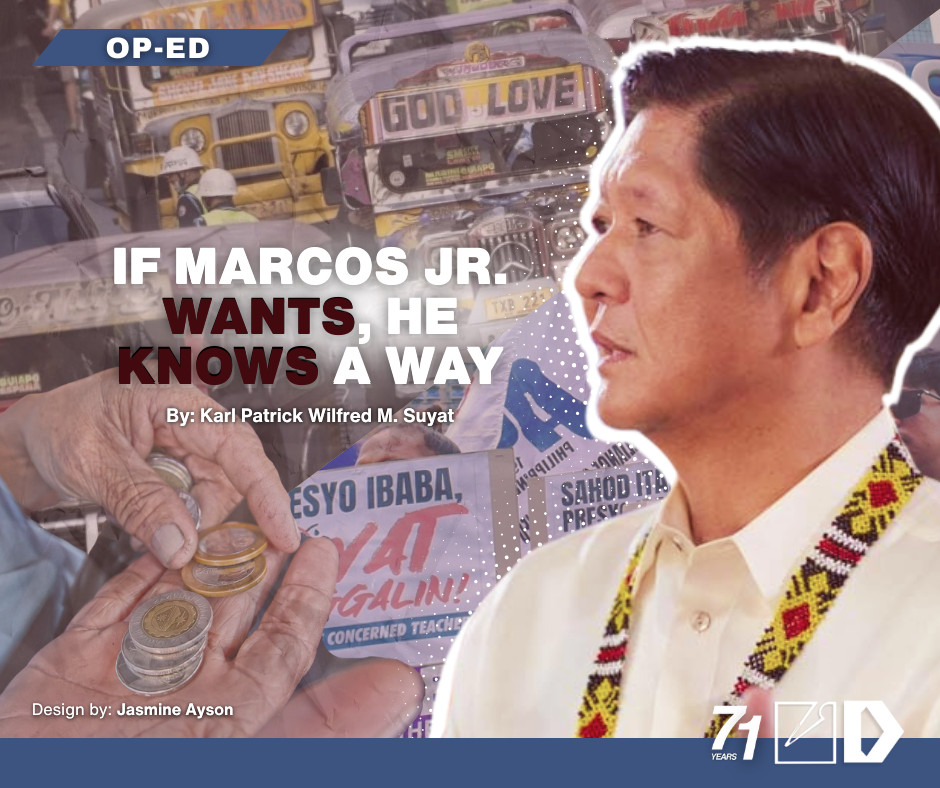
President Ferdinand Marcos Jr. hopes to paint a reality that the current socioeconomic crisis besetting the Filipino public is outward, not inward. He wants the public to “not be affected” by the crisis “we are facing” in West Asia. “Dito lang sa Pilipinas, normal lang muna ang ating mga presyuhan,” he said after a televised market run. There’s no need for hoarding, there’s no need for panic, everything is normal.
Except that this picture, conjectured by the Marcos Jr. government, is not entirely grounded in reality. It isn’t normal; prices are spiraling, and the people are beginning to panic.
For instance, President Marcos Jr. asserts that the country’s fuel supplies are not depleted. “Right now, we don’t have a problem on [our] food supply. We don’t have a problem on [our] supply of petroleum products, including fertilizer for the farmers.”
He refuses, however, to shed light on the fact that 95% of the Philippine fuel supplies are imported, and 98% of our crude oil comes from the besieged West Asia region.
Oil prices have now reached their highest ceiling. Diesel is now pegged at P39 to P49 per liter, while gasoline has risen to P22 to P31 per liter. Cumulatively, various gasoline stations have now put their prices between P60 and P120 per liter. This is the first time that Metro Manila has been hit by such a rapid increase in oil prices.
Transport workers are now being pushed to the brink. If one follows the estimation by militant transport union PISTON: If a jeepney driver consumes 30 liters of diesel every day, their average cost on crude oil rises to P3,600 per day.
News headlines are awash with stories of how some drivers are now forced to skip their meals to be able to take home P300 in daily earnings, a sharp decline from their usual daily income.
When fuel prices hike, inflation and the cost of basic needs follow. The country’s inflation rate closed at 2.4% last month, but the Department of Economy, Planning, and Development (DEPDev) had already made a dire projection: Should global war and conflict persist, the country’s inflation rate could skyrocket to a staggering 7%.
DEPDev Secretary Arsenio Balisacan has already simulated two possibilities: the first projects a 5.1% inflation rate this month, while the second forecasts a 7.5% inflation rate until April. Either way, both scenarios will breach the Marcos government’s 2% to 4% “comfortable ceiling” for inflation.
Such a trajectory primarily stems from the rapid increase in the cost of fuel, food, and other basic commodities. A report from GMA Integrated News also said that the government’s main economic driver “was expecting inflation to already pick up due to base effects given [the] low inflation environment seen in 2025.” Nevertheless, the sudden oil price shocks had indeed sent its shockwaves through our local economic inroads, and Balisacan himself is bracing for the worst.
Under these extreme circumstances, where the cost of almost all of our basic needs surges exponentially, progressive research institution IBON Foundation made a bleak forecast: “[T]he national average purchasing power of the peso, which is already at just P0.79 at present—could fall to P0.74 and even further to just P0.73.”
The country’s economic data are, at the very least, worrisome, although such a softball term is inadequate to picture the full extent of this crisis. But what’s worse is that this administration, including Marcos Jr. himself, fails—or deliberately refuses—to recognize that the problem isn’t only outward nor out of its control.
While Donald Trump and Benjamin Netanyahu’s war of aggression against Iran did contribute to the unravelling of the country’s economic situation, other inward forces—and systems—are more crucial in jeopardizing the economic welfare of the Filipino. Certain solutions, therefore, lie outside of the geopolitical context. This quagmire is expressed more definitively in the case of the country’s oil industry.
*****
In the last few weeks, protestors have directed their righteous outrage at the Philippines’ top oil conglomerates: Shell, Caltex, and Petron.
The latter is a mesmerizing example: Formally established in 1973-74 as a national oil corporation (Petrophil Corporation), when the Ramos administration made a heavy bid for privatization in the 1990s, Petron was swept along with the encroachment of private control in supposedly public firms. San Miguel Corporation (SMC), once owned by the late Marcos crony Eduardo “Danding” Cojuangco, acquired majority control over Petron in 2010. Even when Ramon S. Ang, a Cojuangco protege and his successor in the SMC empire, proposed to “sell back” Petron to the government in 2021, SMC still retained control over the company, including its oil pricing.
In the case of Petron alone, which supplies “more than a third” of the country’s oil supplies, the invisible hand of capitalist domination has already made itself tangible. How much more in the cases of Shell and Caltex (which are not even national in nature—since they are multinational firms)? Yet a bigger evil lies behind these oil firms’ rat race for profit, which enables them to increase oil prices without any consequence.
In February 1998, during the last leg of the Ramos administration, the Philippines passed into law Republic Act 8479, the infamous Oil Deregulation Law. From the word itself, oil deregulation means that the country’s oil industry will be liberalized from state control, from pricing to trade restrictions.
A 2000 paper published by the Philippine Institute for Development Studies (PIDS) offered a vital background context: “Prior to RA 8479, the Energy Regulatory Board took into account the dollar cost of imported crude oil and the foreign exchange rate, and fixed prices of petroleum products. A budgetary allocation maintained by the national government called the Oil Price Stabilization Fund (OPSF) automatically absorbed any price change incurred by the oil companies in importing crude oil, which is not reflected in the selling price.”
When RA 8479 became law, OPSF was abolished, and the local oil industry essentially went under the full auspices of hegemonic corporate control. Petron is a seminal proof of how the lethal combination of privatization and deregulation—through RA 8479—severely impacted, and still impacts, the country’s oil and economic quandaries.
But RA 8479 does not stand on its own. The triumvirate of privatization-trade liberalization-deregulation is the vanguard of a larger economic onslaught on our local economy, code-named neoliberalism. Huge word.
*****
In the book Invisible Doctrine: The Secret History of Neoliberalism, George Monbiot and Peter Hutchison defined neoliberalism as the ideology “whose central belief is that competition is the defining feature of humankind.” They added, “The market, it contends, will… determine who deserves to succeed and who does not.”
The Marxist social scientist and writer David Harvey furthers his own delineation of neoliberalism in his book, A Brief History of Neoliberalism: “[Neoliberalism] holds that the social good will be maximised by maximising the reach and frequency of market transactions, and it seeks to bring all human action into the domain of the market.” Harvey also posited that neoliberalism is not a mere abstraction; it exudes influence from its locus, the “neoliberal state.”
Such a neoliberal state ensures “freedom,” but freedom for whom? In Harvey’s words, “[t]he freedoms it embodies reflect the interests of private property owners, businesses, multinational corporations and financial capital.”
In the Philippines, the faces of such neoliberal state are two American multilateral institutions that have since flexed immense influence over our local economic planning: the World Bank (WB) and the International Monetary Fund (IMF).
The Ramos administration’s Philippines 2000 was a huge smokescreen to couch the creeping presence of neoliberal principles in our economic polity—in the form of oil deregulation, privatization of former nationalized firms, even the country’s introduction to the World Trade Organization’s General Agreement on Trade and Tariffs (GATT) in 1995—but it was merely the apex of neoliberal intrusion into our economics.
Philippine-style neoliberalism, after all, stemmed from the Marcos Sr. dictatorship’s acquiescence with the WB and IMF’s so-called structural adjustment and stabilization programs, in exchange for its onerous loans to the Filipino despot. However, the presidents who followed the dictatorship, especially Fidel V. Ramos, had perfected the local neoliberal model.
Neoliberal globalization has mangled the country’s economic policymaking to the point that most of Philippine economic servicing and trade commitments were tailored to favor foreign monopolistic interests, instead of the country’s own needs.
*****
The sad case of our oil industry is stark evidence of such an unequal status quo. Bulatlat’s Arnold Padilla makes a clear case as to how oil deregulation, a pillar of the country’s neoliberalization, mirrors The Shock Doctrine: While poor Filipinos are buffeted by steep oil price hikes, “consumers in our ASEAN neighbors are well protected by their governments from the devastating impacts of the ongoing oil shock.”
In Indonesia, Thailand, and Malaysia, their governments maintain “state regulatory mechanisms and subsidy schemes” to guard their populations. Padilla cited important evidentiary data: Unlike in our oil situation with Petron, or even with Shell or Caltex, Indonesia’s state-subsidized oil firm Biosolar had fixed prices, Malaysia’s subsidized diesel’s prices hardly changed, and Thailand subsidized its Gasohol 95 (gasoline mixed with biofuel) through the state’s Oil Fuel Fund.
These crucial measures cushioned the impact of the West Asia conflict on their oil prices, and while their non-subsidized gasoline has seen increases as a result of the war, it was not as rapid or dramatic as in our case.
“Compared with Indonesia, Malaysia, and Thailand,” Padilla concluded, “Philippine fuel prices are the most exposed to global price spikes due to deregulation.”
Beyond deregulation, regressive taxation has worsened the country’s economic situation. The Arroyo-era Republic Act 9337 imposed a 12% value-added tax (VAT) on electricity, petroleum products, and other basic goods, while Rodrigo Duterte’s controversial Tax Reform for Acceleration and Inclusion (TRAIN) Law had added an excise tax on fuel—to supposedly amalgamate the country’s revenue generation for Duterte’s Build, Build, Build infrastructure bonanza and other government programs. VAT and excise tax on fuel, as Filipinos realize today, are a fatal combination.
Who, then, benefits the most from such neoliberal impositions on our economy? The bourgeoisie class: oil cartels and monopolies, billionaires, huge corporations, and the same imperialist nation that had mounted large-scale assaults—without provocation—against Iran, which has also sparked this protracted crisis.
*****
President Marcos Jr. need not look any further if he hopes to see both the root causes and the solutions to this crisis bedeviling Filipino consumers and basic sectors.
Such a crisis might appear outward, but it is actually inward, embedded in the country’s economic systems and policies that are overshadowed by neocolonial domination and class bias but are nevertheless vulnerable to the fluid cycle of global realpolitik. The solutions, then, are also inward.
Instead of begging oil companies for “staggered” oil price increases, he can choose to dismantle the country’s neoliberal economic framework, roll back deregulation and privatization schemes, and nationalize Philippine oil, in order to reclaim full control over the country’s oil and other vital industries.
Instead of requesting emergency powers to simply “reduce” excise taxes on fuel, he has the choice to scrap excise tax and VAT on fuel and other basic necessities altogether, and amend the country’s regressive tax measures.
Instead of admonishing ordinary folk to “tighten their belts,” he can instead impose a wealth tax on the top Filipino billionaires and corporations. Wealth tax would hardly clip Petron’s P15.6 billion 2025 net profit, or Ramon Ang’s cumulative net worth, or that of the Sy family or the Villar business empire.
President Marcos Jr. has the choice, the wherewithal, and the power to make drastic changes to cushion or arrest the debilitating effects of this exacerbating socioeconomic crisis. His government does not need to settle for hollow press releases, pictures of ayuda distribution, or solicitations to private oil firms to exemplify decisiveness in the midst of this volatile situation.
He has everything within Malacañang, within the trappings of state power, to restrain oil conglomerates and other market forces exploiting the vulnerabilities produced by the American-Israeli aggression in West Asia to rake in higher profits, in the true spirit of Naomi Klein’s disaster capitalism.
But that rests on a huge if. That should rest on an assumption that President Marcos Jr. will want to do what the Filipino people need and deserve, and not succumb to what capital and corporations want, even if that means betraying his own friends and cronies. Yet the reality is opposite: Marcos Jr. has even skedaddled from an earlier decision about provisional fare increases for public utility vehicles.
That’s a mercurial assumption, but if the president genuinely understands the predicament of this nation, and if he wants the people to withstand this crisis, he knows what to do—and how. All it takes is his choice—not just political will, but a willful choice.
Will he do it?
But whether or not he does it, the struggling Filipino has another choice. To quote socialists: Strike is the weapon of the oppressed. Some of them are choosing that “weapon” this week. The Marcos Jr. administration should watch out.