

TW: Mentions of sexual abuse and harassment.
For generations, the community within the College of Media and Communication (CMC), built by democratic and compassionate student leadership, fostered a space where a marketplace of ideas could flourish. Even in a university embroiled in turmoil, CMC stood in solidarity with various advocacies while remaining a space for critical discourse.
Now, the college is facing a crisis over student representation after no seat was filled in the recently concluded CMC Student Council (CMCSC) special elections. With vacancies haunting the student council, how should students place themselves in the wider marketplace?
The special elections were held from October 15 to 16, 2026, months after an initial five-candidate roster withdrew from the local regular elections, held alongside the University Student Council (USC) polls in May.
Out of 964 eligible undergraduate and graduate students, 570 of them voted, equivalent to a turnout of 59.13%. The candidates were Guia Marie Mistades for Chairperson, Andrew Nicoli Dela Plana for CMC Representative to the USC, and Jhames Aaron Paredes for Community Councilor, all running under the all-independent Táyo na Maskom slate. None secured a sufficient mandate, with abstain votes exceeding each candidate by at least 15 percentage points.
Even before these elections, the treatment of abstention was already contentious.
On October 7, the College Student Electoral Board (CSEB) received a position paper from the candidates expounding their views on how votes for abstain should be considered in proclaiming the results.
While the paper was not made public, the CSEB stated on the college’s Facebook page that the candidates argued that “abstain votes should not be treated as an individual candidate for purposes of ranking candidates or determining who may be proclaimed.”
The CSEB still retained abstention as an option, citing a decision made by the University Student Electoral Tribunal in 2025, where the winning candidate for the USC Vice Chairperson was proclaimed in spite of abstain votes being the plurality.
RELATED: [COMMENTARY] The erosion of choice
In addition, CSEB asked student organizations in the college, including its recognized publication Tinig ng Plaridel, about their respective stances on the “abstain” vote. According to their statement, seven formations have submitted position papers, all agreeing that “abstention is a legitimate expression of the voters’ assessment of the candidates.”
The contradiction between the viewpoints of aspiring council members and student-led formations forms a clear and glaring conflict between the institutions that are supposed to work hand-in-hand in advancing student interests. While a community as diverse as that in CMC is bound to disagree, this dilemma concerns a fundamental function that enables the studentry to express such disagreement.
It is also important to note that two out of the three candidates running already had experience in running for positions in the student council.
Chairperson candidate Guia Mistades ran in 2024, while CMC Representative candidate Andrew Dela Plana ran in 2025. Both previously ran for Journalism Representative and won despite the presence of abstain, receiving 79.2% and 88.18% of the vote, respectively.
If both candidates already experienced overcoming the abstention votes on their own merit—which affected certain university-wide positions in the previous years—it is important to ask: Was it the fear that they would fail to overcome abstention votes a second time that pushed them to submit a position paper? Was that decision inevitably a catalyst that led to their loss?
All discussions surrounding the abstain vote are mostly run under assumptions. During the May 2026 regular student council elections, explanations for why students abstain boiled down to what people believed was either apathy or disdain against those running, at the expense of having a council. These multiple reasons cannot be verified as there is no concrete data to support any of these claims; hence, campaigning against abstentions to counteract voter fatigue could not warrant any legitimacy to the students.
Returning to the previous CMCSC elections, the contrast between the level of abstentions against USC candidates compared specifically to CMC is immense, and an insight as to how local student leaders are viewed. For comparison, in 2024, the regular elections for the USC resulted in no university-wide positions being filled, as only some college representatives were elected. Included among these elected was Ciro Quiapos, then-CMC representative to the USC that had six other people elected in the CMCSC in the same year.
This dynamic is reflected also in how the candidates themselves allied—or did not ally—to university-wide coalitions, as shown in the past.
Before 2023, the local chapter of Student Alliance for the Advancement of Democratic Rights in UP (STAND UP) party-alliance was the most dominant force in CMC politics. However, in light of the controversies implicating its parent organization in the mishandling of sexual harassment and abuse cases, STAND UP CMC withdrew its candidates in the year’s elections. Five out of six of them ran under a slate of independents: Sulong Maskom.
The year after, Sumabay na Maskom emerged as another set of independent candidates, which included Guia Mistades. By 2025, after realizing the implications of independents repeatedly running under slates, Ciro Quiapos, running as chairperson at the time, led a new, institutionalized political party in the college: Advance CMC. While it did not affiliate with the university-wide Laban Kabataan coalition, it was able to win all seats it contested, including Andrew Dela Plana’s.
Advance CMC intended to continue establishing its presence by entering the 2026 regular student council elections, following the ratification of a new constitution by the party’s members elected in CMCSC. Yet, its eventual withdrawal stemmed from the candidates disagreeing on whether to align with the Sulong Tayo Coalition, which went on to lead the USC.
According to Quiapos’ May 22 Facebook post, this disagreement came from unresolved abuse, harrasment or rape (AHR) cases, eclipsing certain formations in the university, which stemmed from STAND UP’s 2023 collapse.
Particular to Advance CMC’s withdrawal, the previous USC was shaken by College of Arts and Letters (CAL) Representative to the USC Jobert Pillas’ arrest over alleged violations of the Anti-Rape Law (RA 8353).
According to the same post by Quiapos, the mental strain experienced by then-CMC representative to the USC Alyanna Avergonzado in raising questions about the case impacted the CMCSC—the same CMCSC where four of its incumbent officers were in the pre-withdrawal Advance CMC slate, including Avergonzado as chairperson and Dela Plana as CMC representative.
With many of the implicated student organizations forming part of the now-defunct STAND UP, of Laban Kabataan and eventually of Sulong Tayo, this timeline reflects one conclusion: many of the student leaders in the college are willing to go against the “currents” of the progressive student movement in UP Diliman—not necessarily in their beliefs, but in their actions—to prioritize the welfare of the CMC community.
As far back as 2023, there were attempts to initiate a process to seek justice for the victim-survivors within STAND UP, with its CMC chapter willing to lead if inaction persists. However, the promise of “rectifying errors” has yet to be seen in fruition, as the party-alliance is now dormant in recent elections. Since then, tackling cases of sexual harassment and abuse has become the kryptonite of the local student movement within UP Diliman in recent years.
Despite progress being made, uncertainty surrounding these cases continues to unsettle constituents. For instance, while Pillas was suspended from the USC days after he was arrested, the case was reportedly dismissed in May 2026, and more recently, in August, his legal team threatened student publications such as SINAG and Kalasag to be sued for libel, claiming “reckless character assassination” against him on their reports.
The wider implications of this incident, which upholds the principle of “innocent until proven guilty,” refer to the idea that Pillas roams around the campus freely, while justice for the victim-survivors remains up in the air without a clear resolution. This is enough to generate anxiety among members of the student body who are aware of Pillas’ alleged wrongdoings.
These instances evidently point to how sensitive a topic it is in recent student council elections, regarding how our potential leaders handle, or are expected to handle, sensitive matters, especially AHR cases.
Indeed, discussing these cases publicly could further affect victim-survivors, whose experiences risk being brought to the forefront primarily to serve political arguments. No one wants their deepest trauma to become the center of heated debates, not even those who speak about them.
However, in order for the community to properly approach this, it is imperative that questions about alleged sexual misconduct are not dismissed, regardless of their nature or severity. Such discussions must, of course, be approached with proper consent, without the intention to open the floodgates of malicious rhetoric or exploitation.
They may be hard to hear, let alone speak about, but it is a matter that demands the utmost sincerity and sensitivity.
Perhaps this is why many students of Maskom value abstention as a valid vote and should not be removed simply to fill seats. For many years, students have heard every single rewording of a “victim-centered approach” from various candidates. Yet, the perceived inaction by the very institutions students should trust pushes voters to be jaded towards student leadership.
Platforms, advocacies and plans of action matter less if the candidates themselves fail to show proper leadership in the most dire of situations, even when they were or are already in positions of power. If they are capable of standing true to their convictions on sensitive matters brought up in the campaign, then they should expect that the student body will hold them accountable for making decisions that align with these principles.
To see student leaders as human is just. To empathize with them at their lowest is just. So is to be critical when they are in the wrong. Students will abstain if they believe that any form of “conscience voting” cannot change their convictions on whether these leaders are worth the vote.
Abstaining has always been in the interest of democracy, no matter how others would spin it. Though it cannot enter classrooms to solicit votes, it is a mechanism used when the student body cannot see themselves being genuinely represented by any candidate.
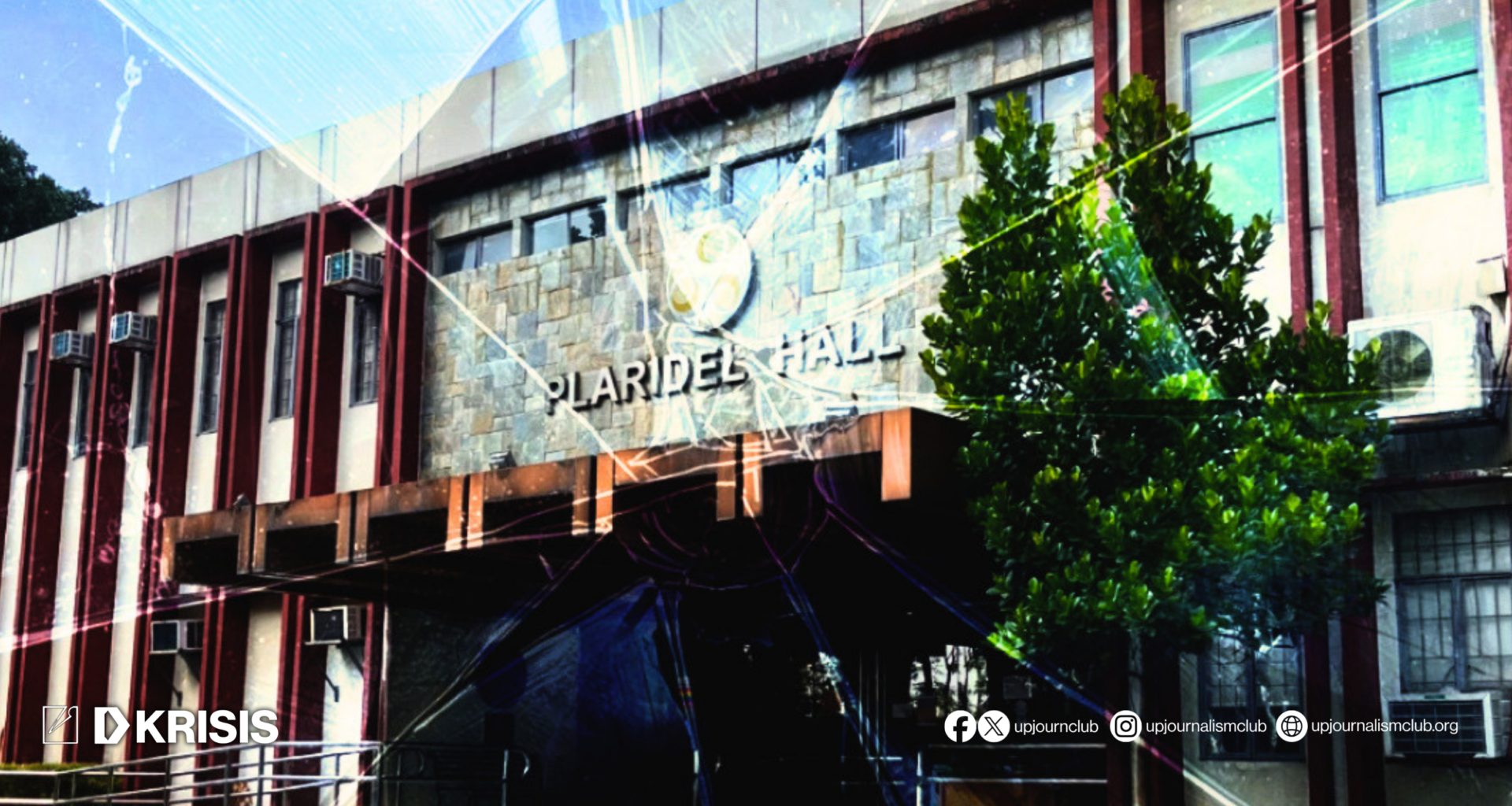
To throw abstain into the wastebasket of the debate is an insult to the student-voters of CMC, whose critical voices are as crucial in defending the rights and welfare of members of the media, the students, and the broader communities outside UP as that of the candidates who threw their hat in the ring. “Magmulat, maglingkod, makibaka” should not end as a slogan reverberating in front of Plaridel Hall, but as a steadfast commitment that the whole CMC constituency must uphold and exemplify even beyond the elections.
An empty council is detrimental to its constituents in addressing their concerns and advancing their campaigns. It would, however, be more detrimental if those who lead them were chosen against the will of a clear majority.
This is not to remove the fact that youth repression is getting worse. Students are suspended by school administrations merely for questioning military presence inside their campus. Students are preyed on for holding certain beliefs and speaking out for them. Students even lose their lives at the hands of state forces merely by learning beyond the four walls of the classroom through communities.
Students are constantly confronted by manifestations of imperialism, feudalism and bureaucrat capitalism: shrinking allowances amid rising food, rent, transportation and other expenses; and underfunded, unfinished or dilapidated spaces diverted to “development projects” that benefit the ruling class more than the ordinary Filipino.
Yet, these struggles do not mean that demands for a safe, inclusive and fair environment should be set aside for the sake of certain student leaders to be seated. When we are already surrounded by the horrors of the real world, how can we turn to spaces meant to offer us comfort, trust and security when we cannot be certain that these, too, will be upheld?
“In the line of fire is the place of honor,” said the late student leader and former USC Chairperson Lean Alejandro. It should also be the place of safety and open discourse. We owe it to the students who put themselves in the frontlines when democracy was challenged, even as it still is.
The power student leaders hold does not emanate from popularity or experience alone. It comes from everyone involved in the democratic process. From students, to professors, to security guards, to utility workers, to jeepney drivers and to maninindas selling snacks in kiosks.
This is why we must remain critical. To question. To vote—even to abstain.
The line that we have to hold may shatter at any time. But our constant persistence has proven, historically, that it could never break under intense state pressure. History has attested to this, from the Marcos Sr. regime suppressing the right to organize, until the impunity that took the lives of martyrs like Alyssa Alano, Maureen Santuyo, RJ Ledesma, and the college’s own Kal Peralta.
We are not beholden to the existence of institutions in order for us to organize and mobilize, as shown in the wide history of the student movement.
To tamp down the voices of the students is to go against genuine representation. We unite, struggle, and unite not for the sake of superficial accomplishments, but to create a community, one that nurtures its people and compels them to act. This is an aspiration the college must not lose sight of, one that can be remembered by heeding its people’s calls, even if it leads to more months of an empty student council.